Symbol Archives - Jansankalp Foundation

Septor Summary by Balaji P. Krishnammagaru

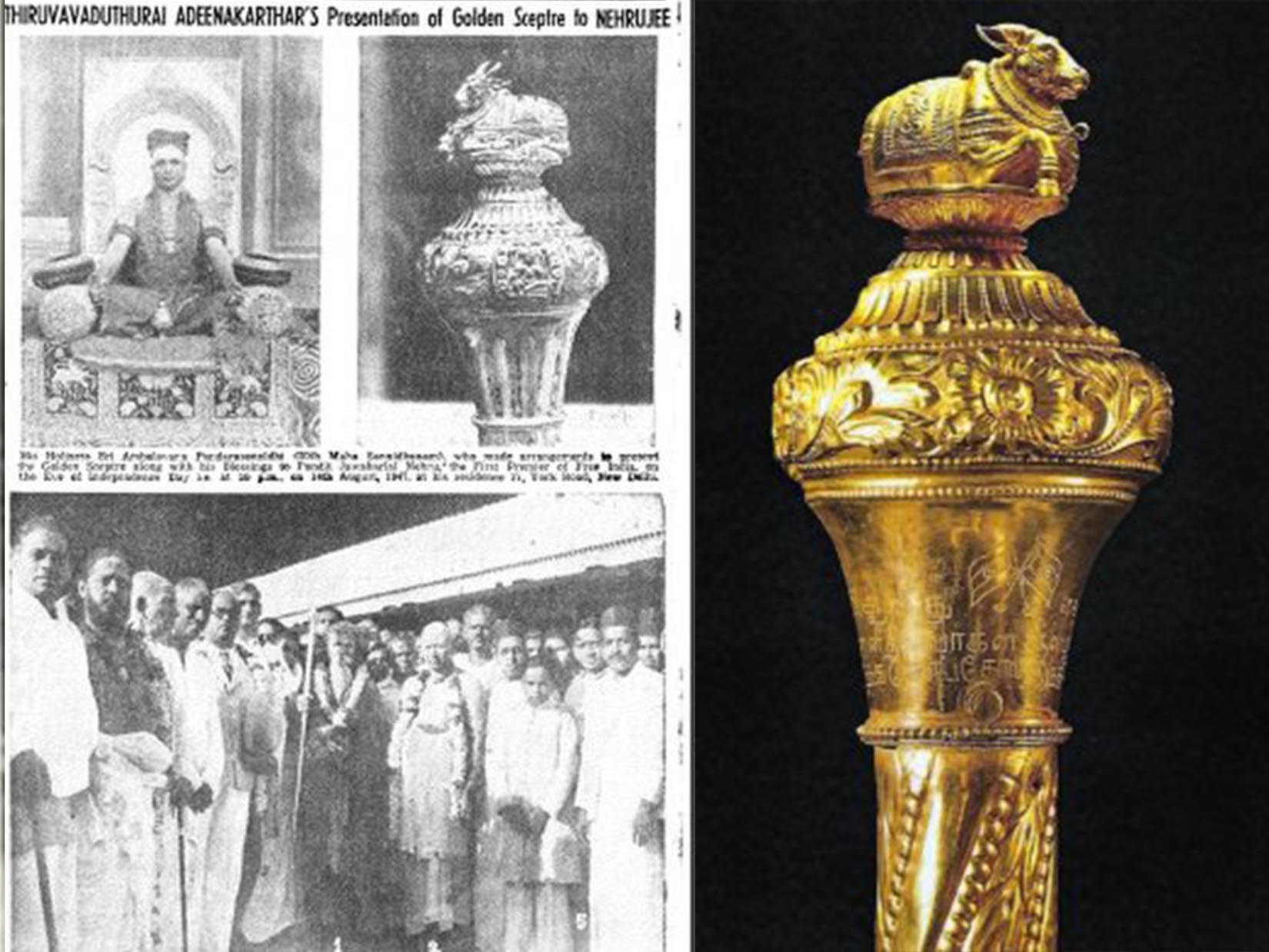
Some of the references of the Sengol. While I intend to write in detail about the Septor, different versions floating around. My endeavour is to give first-hand documentation with available references.

The letter is mentioned in the book “e Transfer of Power in India” by Penderel Moon. Moon was a British civil servant who was present in India during the transfer of power. .The book “The Transfer of Power in India” by Penderel Moon is page 441. The letter is from the Maharaja of Mysore to the Viceroy of India, Lord Mountbatten. In the letter, the Maharaja asks Mountbatten to arrange for the Sengol to be presented to the new Prime Minister of India, Pandit Jawaharlal Nehru, on the occasion of his taking office on 15 August 1947. The Sengol is a sacred scepter from Tamil Nadu, and the Maharaja believes that it would be a fitting symbol of the transfer of power from the British to the Indian people.

Here is the full quote from the letter:

I am writing to you to ask you to arrange for the Sengol to be presented to the new Prime Minister of India, Pandit Jawaharlal Nehru, on the occasion of his taking office on 15th August 1947. The Sengol is a sacred scepter from Tamil Nadu, and I believe that it would be a fitting symbol of the transfer of power from the British to the Indian people.

The Sengol is a symbol of the authority of the Maharaja of Mysore, and it has been in the possession of my family for many centuries. It is made of gold and encrusted with precious stones, and it is a very beautiful object.

I believe that the Sengol would be a fitting gift for the new Prime Minister of India. It is a symbol of the ancient traditions of India, and it is a symbol of the authority of the people. I hope that you will agree to my request and that you will arrange for the Sengol to be presented to Pandit Nehru on the occasion of his taking office.

The Sengol was indeed presented to Pandit Nehru on 15 August 1947, and it remains in the possession of the Indian government to this day.

The letter is also mentioned in the book “The Discovery of India” by Jawaharlal Nehru. In his book, Nehru himself writes about the Sengol, saying:

The page number of the quote in the book “The Discovery of India” by Jawaharlal Nehru is page 578. The quote is from the chapter “The Transfer of Power”, and it is part of a larger passage in which Nehru describes the events of 15 August 1947, the day that India gained independence from the British.

Here is the full quote:

On the morning of 15 August 1947, I was presented with the Sengol, a sacred sceptre from Tamil Nadu. It was a symbol of the transfer of power from the British to the Indian people. I received it with a deep sense of humility and gratitude. I felt that it was a great responsibility that had been placed on my shoulders, and I vowed to do my best to live up to it.

The Sengol is a sacred sceptre that has been in the possession of the Maharaja of Mysore for many centuries. It is made of gold and encrusted with precious stones, and it is a very beautiful object. The Maharaja presented the Sengol to Nehru as a symbol of the authority of the people and the ancient traditions of India.

Nehru was deeply moved by the presentation of the Sengol, and he saw it as a sign of the people’s trust in him. He vowed to do his best to live up to their expectations, and he worked tirelessly to build a new India that was free, democratic, and prosperous.

Although the letter itself is not publicly available, the references to it in other documents provide some evidence of its existence. The letter is a significant historical document that represents the transfer of power from the British to the Indian people in 1947. It is a reminder of the sacrifices that were made and the struggles that were overcome in order to achieve India’s independence.

Rigveda Linguistic Analysis and Origins and Myths of Verna, IVC and Vedic Culture and Evolution of Mahadev. Balaji Krishnammagaru

Balaji Krishnammagaru – Jansankalp Foundation

A Pure Linguistic, Archeological, Science based Materialistic View on My Faith

  1. Pre Vedic Roots of Mahadev \ Pashupati \ Shiva \ Rudra \ Worship of Linga
  2. Rigveda (apauruṣeya , Śruti ) and its Origins in India and a Parallal , Intertwined Pastoral \ Semi Nomadic and Village culture with Urban Centered Indus Vally Culture
  3. Importance of River Sarasvati (For Rigvedic Roots in India)
  4. Indus Valley Civilization
  5. Origins of Yoga
https://en.wikipedia.org/wiki/Pashupati_seal

Association of Mahadev with Lingam is also another aspect. After all I came from Tirupati and I will refer to Gudimallam

https://en.wikipedia.org/wiki/Gudimallam_Lingam

Note: This is materialistic view of my own faith . I call this other side of coin, Science . Here, my own perception as a human being, who is convent educated and science focused view . I will write someday on my own belief systems purely on faith . I am hope both will converge some day which I call it as Moksha 🙂 ? finding the ultimate Truth ? Who knows I will take concepts from Bramhanda Purana, Bramha Purana and other “Ancient Theoretical Physics” papers written thousands of years back by observations , attached God to it so that people would read with “Shradda” and debate and make it better by debating using Tarka sastra . Unlike other scriptures . Scriptures in Bharata are to be treated as theoretical scientific papers and to be debated , discussed , updated can also propose alternate explanations .

Dharma is empirical in nature and is not fixed. I always give one example. The Dharma of a King 1000 years back is to kill Tigers to protect people and go on hunting expeditions . But, Dharma today is to protect the same Tigers as their population is dwindling . Dharma is so simple. Today I am duty bound to follow constitution of India and still debate clauses \ laws if anything is outdated . Its not fixed .

Now coming to the subject , the generally accepted date for Rigveda is much earlier to 2000 BC and often goes back to 4000 BC. Its origins are in Bharath as there were numerous references to River Saraswathi which dried out in 1500 BC. There are many emerging evidences in IVC sites (I am not giving any references for now) with fire alters and other Vedic Elements .

Here, Iam not writing in a structured way, there are many tangents proposed and I will make efforts to write about each tangent. The idea is to establish or find truth with scientific acceptable geological, linguistic , gene mutations and actual archeological evidences and connects the dots.

Linguistic analysis and reordering based on language constructs

Rig Veda were recomposed, passed down orally for 10ks or 1Ks of years . Then some time around 3000 BC this wisdom started taking shape in the form of Rigveda . Written down much much latter than and is organized as Mandalas and were rearranged for easy reading, not in the order of recomposing (I use the word recompositing . Sruthi is not Text. Its word of God). The current arrangement we have today is believed to be the work of Vedic scholars between 900 BC and 500 BC. (Again I am not going to give references for now)

But how do we know this?

Linguistic and stylistic analysis along with Astronomical and Archeological evidences helps us understand the accepted chronological order of the Mandalas, which is different from their current arrangement. Scholars have also categorized the Mandalas into three general groups based on Vedic, linguistic, and historical analysis.

So, what does this mean for us? It highlights the rich history and evolution of the Rigveda over time, as well as the incredible efforts of Vedic scholars to preserve and make sense of these ancient hymns.

Do you find the study of ancient texts fascinating? Share your thoughts and let’s discuss the significance of understanding the origins and development of sacred texts like the Rigveda. #Rigveda #AncientTexts #Hinduism #sanathanadharma #dharma

Recomposed or received by Seven Sages

If you take lineage, then Bramharshi Atri and his family writings are all over the Rigveda . The Legendary Bighu Maharshi for Brigusamhita.  Vashishtha Mahamuni, Maharshi Bharadvaja , Bramharshi Vishvamitra , Gautama , Jamadagni and then again Vamadeva,  Gritsamada in the order are considered the oldest both as per lineage and linguistic analysis  of the Rigveda as they are directly referred to each Maha Rishi (One of the Seven Saptarishis. Again there are multiple versions of Saptarishis , I will talk about this and names in a separate article). Technically these, mandalas are written by Maha Rishis, Bramha Rishis , Sages , Vedic Scholars and his Family, sometimes two to three generations. So, let roughly rearrange as follows

  1. Mandala 6 (recomposed by Maharshi Bharadvaja family) (addressing the deities Indra and Agni, but also Varuna, the Vishvadevas, the Maruts, and others)
  2. Mandala 3 (recomposed by Bramharshi Vishvamitra family)
  3. Mandala 7 (recomposed by Sage Vashishtha family)
  4. Mandala 4 (recomposed by Vamadeva family)
  5. Mandala 2 (recomposed by Gritsamada family)
  6. Mandala 5 (recomposed by the Sri Sri Sri Bramharshi Atri , Mata Anasuya and family. Bhamharshi Atri’s clan verses are all over the Rigveda and THE major contributor for recomposing of RigVeda for nimittamatras)

Madhya mandalas

Mandala 1 and 8 are considered to be composed later than Maharshi’s family Mandalas but still have older elements. Their order is as follows:

  1. Mandala 8
  2. Mandala 1 (Yes, this is what you read first)

Most latest

Books 9 and 10 are the most recent Mandalas in the Rigveda. Book 9 is dedicated to the Soma, and Book 10 contains the famous Purusha Sukta. The order of these Mandalas is:

  1. Mandala 9
  2. Mandala 10 (Mostly written and I would not be using entirely as recomposed. When we go in style of each Verse, we can date it with out any issue)

Again, there are variations in the order of individual hymns within each Mandala and insertions and deletions of verses as most of the Vedic tradition is carried out orally.

Now, given the fact that all present Rigvedic Pundits take from one to ten , its essential to make them sit and see if they First Hymn is indeed first Verse.

Tenth Mandala: Issues start from here with Soma, Purusha and Varna.

Here “Varna System” in the Rigveda appears in the “Purusha Sukta” of the 10th Mandala (Rigveda 10.90), where the four varnas are said to have originated from the body of the cosmic being Purusha. Generally this is attributed to Sage Narayana . Needless to say this is much later and may not even be Rigvedic.

Sage Narayana is not Lord Narayana (Mahavishnu) and also Sages of Mahabaratha Nara Narayana.

In the specific Mandalas you’ve mentioned, the concept of varna may not be as explicitly addressed as in the Purusha Sukta, but the hymns often reflect societal roles and functions that hint at some form of social organization which are not depicted or given any order but just roles in the society.

Appearance of Mandala Ten may be associated with demise of Indus Valley Utopian Urban Civilization. Whereas Vedic is mostly Pastoral Society. Theoretically this appears with much later addition to present form of Rigveda (Word of God – Sruti) and is not as known to Saptarishi or their families. If you read Matsya Purana , you may get some hints . If you see other cultures flood stories including Arc of Noah. There will inevitably similar story of Pralaya and parallels of this story . Again, this is another topic.

Based on the Purusha Sukta from the Rigveda, we have the little unknown Yajnavalkya Smriti and much maligned. misunderstood and misrepresented the Great Manusmriti, which further explore societal structure and Varnas. These are Smrithi (Texts and Interpretations and somewhat like 100BC versions of Max Muller, Michael Whistle and Maha Gnani Mahatma Romilla Thaper who is fluent in Samskritam and Tamil), written down much later say after 100BC. However, even in these texts, the concept of varna is largely contextual and subject to interpretation. When comparing the societal organization outlined in these ancient texts with the evidence of highly organized urban societies like Harappa and Mohenjo-Daro of the Indus Valley Civilization, there are striking differences. For instance, the archaeological evidence from these sites suggests a society ruled by priest-kings, which is distinct from the varna system. The evolution of deities in Hinduism is another fascinating topic. For example, earliest Pashupathi , Mahadev , or simply God, the transformation and amalgamation of the Vedic deity Rudra into THE God Shiva, often referred to as Mahadev, is an interpretation that emerged over time.

(Again there is another tangent which is Shaivism , Vaishnavism and what not. Let me make my intentions clear and take side of My Lord who takes only Belapatra and looks like hunter gatherer)

Why did I take Verna first ? Obviously Iam a Shudra for last 7 Janmas . I am son of Farmer , engineer, service provider. Every service please …) Iam here with an agenda to prove I am of great lineage originated from the Feet of God . This is how we forced all other Vernas to touch feet to give us respect 🙂 🙂 🙂 . Oh God, I spilled out secret essence of Vedas and secret weapon of Sudhras , now no one will touch feet of their elders 🙂 🙂 🙂 . I will continue though.

OK. Now lets be serious ….with all due respect and sastanganamasakarm to all elders of all so called Vernas .

Lets specifically see what societal roles and responsibilities are mentioned in Manadalas associated with Maharshis.

Now, lets analyze oldest parts of Rigveda

  • Mandala 6( Hymn 45 )of this Mandala is dedicated to Rbhus, who are described as skilled craftsmen. They are invoked to grant good fortune, wealth, and long life. This suggests the presence of skilled artisans in Vedic society.
  • Mandala 3 has several hymns in this Mandala are addressed to the Maruts, often described as young warriors with Indra. They reflect the importance of martial prowess in “Vedic” or “Indic” society.
  • Mandala 7 (Hymn 33) of this Mandala describes a conflict between the sage Vasishtha and king Sudas. It showcases the interaction between religious authority (the Brahmins) and political power (the Kshatriyas). (Hey, So, Lord Parasurama was later or older ? Didnt he kill all Kshatriyas ?) (Again this is another topic on my Fav God – Man)
  • Mandala 4 (Hymn 50) Savitr, a solar deity, for protection and guidance. The hymn’s focus on moral guidance and righteous conduct points towards the importance of dharma (duty, virtue, morality) in society.
  • Mandala 2 ( Hymn 12 )of is a prayer to Indra for victory in battle. It reflects the prominence of warfare in this society and the role of warriors or Kshatriyas( what ever, since there were no Kshatriyas, we took weapons to protect others and we were deprived and put in wars even though we were peace loving service providers).
  • Mandala 5 (Hymn 40 )of this Mandala, the Rhishi prays to Saraswati, a river deity, for blessings and protection. It reflects the reliance of Vedic society on rivers for sustenance and the reverence they held for natural elements.

Now, we all know River Saraswati dried out completely before 1500 BC. So, it this depletion should have started much earlier ? Hence all the older verses are written much earlier to and in parallel to Indus Valley Civilization.

Lets connect few dots

King Sudas was a ruler of the Trtsu-Bharata tribe, and Vasishtha was his priest. (Yes, all Bhartiyas, Indians were Sudhras) (But we all know Aryans invaded , the theory still stands in one form or other) According to the hymns, a major conflict known as the Battle of the Ten Kings (Dasarajna) occurred during King Sudas’s rule. This battle was a conflict between Sudas (and his Bharata tribe) and a confederation of other tribes. Vasishtha played a crucial role in this battle as the priest who conducted rituals and hymns for King Sudas’s victory. (Did I give proof for Aryan vs Dravidian fight ? or Dravidian Supremacy over appointment of Priests ? ….what ever … I will use this during elections to divide my tribe and get votes to my nominee )

Now its important to note the conflict between Sage Vasishtha and King Sudas : Now , the root word for Sudhra is Sud . So , there was conflict between Suds and Sage Vasishtha .

The conflict between Vasishtha and Sudas typically refers to a period when Sudas temporarily replaced Vasishtha with the sage Visvamitra as his chief priest. This switch resulted in a rivalry between Vasishtha and Visvamitra. However, Sudas eventually returned to Vasishtha, which further intensified the conflict between Vasishtha and Visvamitra.

Off track Connection between Sud-King Sudas and Shudra : “Sudas” is often translated as “good servant” or “good ruler”. The name can be broken down into two parts: “su”, meaning “good” or “well”, and “das”, meaning “servant” or in some contexts “slave”. In the context of a king’s name, “das” might be better interpreted as “one who serves”, thus making “Sudas” something like “one who serves well” or “good ruler”. But , due to reverse discrimination , Sudas decedents became Shudras 🙂 🙂 🙂 , since Kind Sudas “appointed” Sages , the decedents formed a group and took over temples and Ghats 🙂

Now, to keep you to the subject as I go tangential in every aspect , most interestingly most scholars agree that Rigveda was probably recomposed, rearranged much later and may have happened between or later to 200 BCE and 200 CE, during the late “Brahmanical” period. Some portions of the text may be even later, and other portions may have been added or revised much later. So , now ? how to prove this ? As I am biased ? See , just follow your Dharma and find your truth . See my other article on what is Dharma .


Now, here we go , the Manusmriti was one of the first Sanskrit texts to have been translated during the British rule of India, in the early 19th century. Why ? Any original first translation was based on direct understanding ? or understanding presented by 18th\19th Century Pandits ? Has anyone read original Manusmriti ? I dint.

All these started with our own Sadguru .


@Sadhguru , how did you come up with 15,000BC (Human being) and corrected it to 75K BC (Neanderthal) ??? Thank God , you dint say he is from Type 7 Civilization Alien .

……………………………….a lot more dots …………….lot more to connect ………

How we Intend to Deliver Services in our Clinics?

AxiPHYL , MedOnGo , Jansankalp and Healthcare

Iam NOT Sadhguru. Iam Balaji Krishnammagaru. But, time has come to put checks and balances NOW.

BALAJI WITH MULTIPLE THOUGHTS. TRYING TO FIGUREOUT LARGER IMPLICATION AND FALLOUT FROM ONE TO THREE YEARS

Impact of GAI on Health care and Society.

Advances in Artificial Intelligence and Cost of General Intelligence and Impact on Health Workers, Patients, Families and in General Society as a whole.

The availability of artificial intelligence (ML,DL AI etc) and automated artificial intelligent systems, I will be referring to as Artificial Systems. These are as artificial as Chemical Fertilizers used indiscriminately as against organic farming. If I go little further back in human history, faming based settlement form hunter gatherer to farming was shift which made us come to the spot where we are right now. The advances in AI and GAI in next few years, will have such an impact eternally. So, are we at the juncture of Industrial revolution or at the juncture of fire? Farming based settlements? I feel we are up to a major paradigm shift as fire and farming combined with wheel, invention based paradigm shift. FIRE.

I will try to limit my text to Healthcare. My views are contradictory and conflicting as I myself caught in the middle of writing this paper using AI systems. Yes, I will be. Then using AI in our own organization to keep up with competition and yet, looking just 3 years down the line, I don’t know what position I will take given the rapid inevitable changes.

The healthcare industry has the potential to revolutionize the way medical services are delivered. However, it also raises questions about the future role of health workers and mental conditions of patients, families including doctors and nurses and society in general.

To start with in my first post, we will just touch up on how AI and Automated Systems are affecting the health professionals and patients and what steps primary care doctors and the healthcare market can take to prepare for the next three years. This topic is a low hanging fruit.

  • a. For example, AI algorithms can be used to analyze medical images, such as X-rays and CT scans, to make diagnoses more quickly and accurately.
  • For example, Robotic surgery systems can also perform minimally invasive procedures with greater precision and control than human surgeons.

These advancements have the potential to improve the speed and quality of medical services, but they also raise concerns about the future of healthcare.

In the next three years, the use of AI and Fully Automated Robotic Systems in healthcare is expected to increase, leading to a significant reduction in human touch in delivering care.

To prepare for these changes, primary care doctors and the healthcare market must brace themselves for a roller coaster ride. For example, primary care doctors can focus on developing conscious cognitive skills with heart in mind, such as patient communication, emotional intelligence, and empathy, which are difficult for machines to replicate in any near future. It can replace, but what impact does it have on the care receivers?
The healthcare market can also support ongoing upgrade of their technology to stay relevant and education for health workers to keep them current with the latest advancements in technology.

Additionally, the healthcare industry must also prioritize Health Worker based healthcare that values the personal touch and personal relationship aspect of care. This has immense value by showing love and affection which is impossible to recreate and be lively in front of Patient. This can include creating new job roles that cater to the unique strengths of human healthcare workers, such as patient caretakers and health councilor along with family members. By focusing on Health Worker based healthcare, the industry can ensure that patients receive care that prioritizes their well-being in a more humane way and realistic and natural way.

The way I look is that availability of automated monitoring and help systems in the healthcare industry will bring about significant changes in the next one to three years, leading to fear of job losses and economic hardship for some healthcare workers. However, by focusing on human aspects and bringing out emotional coefficient and consciously training health workers on these aspects will mitigate fear of jobs and also improve healthcare, prioritizing Health Worker based healthcare, and considering the ethical implications of these technologies, primary care doctors and the healthcare market can prepare for these changes and ensure a bright future for the industry.

RADIAOLOGIST, PATHOLOGIST?

Generally speaking, jobs that involve technology and interpretation of these tech routine tasks, such as reading medical images, videos, are more susceptible to technology automation than jobs that require higher levels of skill and judgment, such as patient diagnosis and treatment. Just few year ago a Radiologist was and still is highly paid job. Tele radiology was first step and it seeded the advancements. Radiologists offshore saw that as extra income and are suddenly at the receiving end. As a result, radiologists may be more at risk of their job being downgraded to making a physiotherapist job being seen irreplaceable?

However, it is important to note automation (AI or whatever is artificial) NOT to replace healthcare professionals, but rather to augment their work. By focusing on developing conscious cognitive skills, such as looking at patient socio economic cultural and family back grounds and informing reports in person to the Patient and Family with deeper understanding of the impact of a MRI , CT and for that matter a simple XRay . What we see till date is conclusion written at the end of the report and we searching for deeper understanding using Google. Now, that made is Google Patients. Think if it makes us AI Patients? How do we interpret the results as against a radiologist using the AI?

Now, let’s evaluate roles of Lab Technician, Phlebotomist to a Pathologist. Let’s see a general yearly health checkup reports. It has become as routine as it useless. the rates of tests has come down in all sectors like Hematology , bio chemistry etc .But, we are just a year or two away to connect all dots in the yearly health check up with past years data and give a comprehensive view of health .Its already there in few places .

Now what is the role of Pathologist?

There were many jobs created and lost , the easiest example being Medical Transcription. Why was Doctor needed to write in such detail, when did Doctors got overloaded in the west and how it the Transcription Industry started and faded? AI and GAI are no different.

I would not go in detail further, you can take problem statement and get your answers either in Jasper or ChatGPT. Even good old Google

Yeah, good old Google. I am sure the transformer model they invented found its way across and they are up to something up their sleeves. Till they make their plans public, there is no point me pointing out.

Again, good old Google or Google in new avatar, the change is around the corner in months.

“Avoid Antibiotics – there is light at the end of the tunnel”

WHO has declared that AMR is one of the top 10 global public health threats facing humanity. Misuse and overuse of antimicrobials are the main drivers in the development of drug-resistant pathogens.[1] – Avoid Antibiotics

AMR (antimicrobial resistance genes) is a leading cause of death around the world, with the highest burdens in low-resource settings. Understanding the burden of AMR and the leading pathogen–drug combinations contributing to it is crucial to making informed and location-specific policy decisions, particularly about infection prevention and control programs, access to essential antibiotics, and research and development of new vaccines and antibiotics. Data gaps in many low-income groups especially in India and China, emphasizing the need to expand microbiology laboratory capacity and data collection systems to improve our understanding of this important human health threat.  [2]

Human deaths were caused by drug-resistant infections. Antimicrobial resistance genes (ARGs) — mobile genetic elements that can pass between micro-organisms — help to accelerate resistance. 

More than 1.2 million deaths (disability-adjusted life-years – DALYs) attributable to and associated with bacterial AMR for 23 pathogens and 88 pathogens – drug combinations in 204 countries and territories in 2019.

Two Indian Origin Lead Reasercher Lead by Dr. Poonam Dhindwal PhD and a Post-Doctoral Fellow and her team from Western College of Veterinary Medicine (WCVM) said the presence of gene which encodes for Enzyme named EstZ is capable of inactivating macrolides. (The team of researchers include Poonam Dhindwal, Richa Jain and Charis Thompson Antonio Ruzzini Daniel KosKoa Murray Jelinski from University of Saskatchewan (USask) research team of WCVM.) [3]

Its already known that presence of this gene in animal pathogens but its functions unknown. But the gene was found in the cluster of three other ARGs. Further analysis of this gene against different classes of antibiotic drugs led to discovery against macrolides.  

Macrolides are class of antibiotic drugs (Tylosin, tilmicosin and tildipirosin are some antibiotics) used by Veterinary Doctors for respiratory illnesses such as bovine respiratory disease and liver abscesses and few other diseases.

Now, veterinarians may also understand why these drugs may not be working because of presence of the gene.  

The discovery after analyzing bacteria collected from watering bowls at a western Canadian beef cattle feedlot. What the USask research team discovered is that this gene can break the ring structure of the antibiotic through hydrolysis (chemical reaction caused by water). The researchers said the gene breaks the Drugs ring and corrupts the active shape of the drug.  

Further research is needed on the effects of Human beings and other animals about EstT, from the same team well entrenched under the Global Action Plan on Antimicrobial Resistance (GAP)


#krishnammagaru #antiantibiotic #avoidantibiotic #EstT #MedOnGo #Jansankalp #AxiPHYL
Balaji Krishnammagaru

[1] https://www.who.int/news-room/fact-sheets/detail/antimicrobial-resistance

[2] https://www.thelancet.com/journals/lancet/article/PIIS0140-6736(21)02724-0/fulltext

[3] https://www.pnas.org/doi/10.1073/pnas.2219827120